
What App Review Analytics Actually Costs — And Why Appeye's Free Tier Isn't a Teaser
Sourced from real external announcements and Appeye's own app catalogue.
- Enterprise ASO tools' starting price (Sensor Tower)
- $2,500+/mo
- AppFollow's free-tier cap
- 2 apps
- Appeye's free tier — uncapped
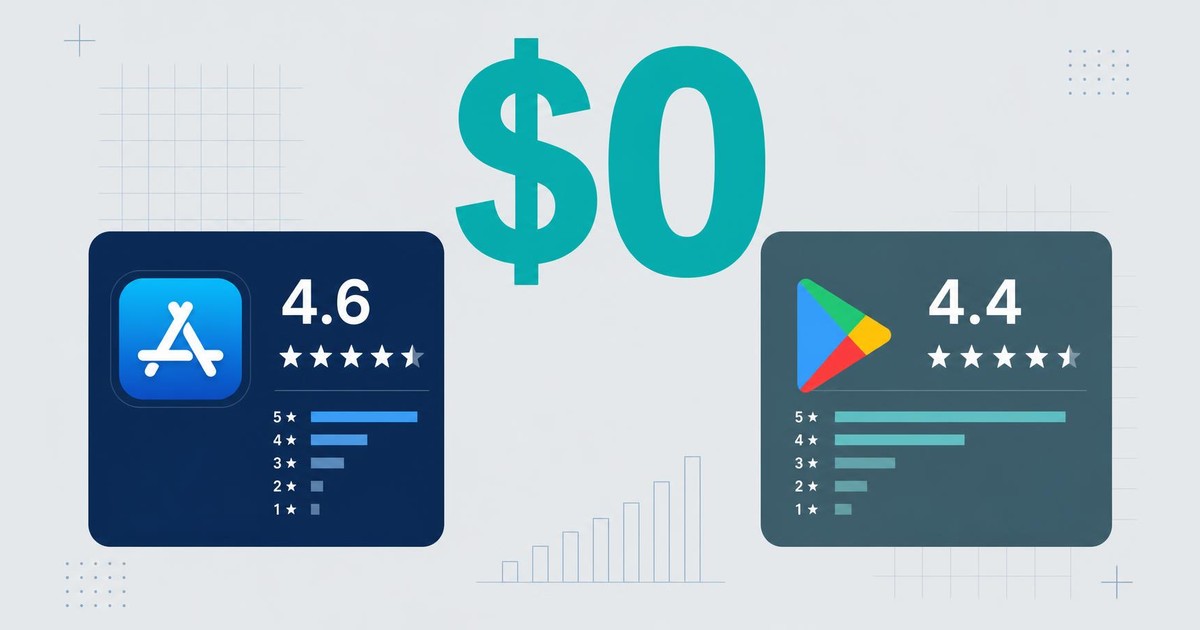
- $0
- Real reviews behind Appeye's scores
- 3.4M+
Chart 1 — Comparison
Chart 2 — Comparison
Ask most app-review analytics tools "what does this cost," and the honest answer is: it depends who you are. AppFollow's plans run from $29 a month up to $459, with a free tier capped at two apps and 1,000 keywords — enough to evaluate the product, not enough to actually run on. Appbot starts at $49 a month. Sensor Tower, the enterprise standard for download and revenue modeling, starts north of $2,500 a month — a price built for teams who need competitor revenue estimates and keyword-rank tracking, not for a solo founder who just wants to know what their own users are saying.
None of that is a knock on those tools — they're built for ASO teams and enterprise marketing departments, and they're good at what they do. But it means the honest, unfiltered picture of how an app is actually doing — sentiment, complaints, category rank — sits behind a subscription that most people evaluating a product, an investor doing diligence, or a small team without an ASO budget will never pay for.
The second thing most of these tools have in common: they analyze App Store and Google Play together. A combined score, a combined sentiment number, a single "how are we doing" answer. That's convenient, but it hides the real signal — an app's iOS and Android users are frequently different people with different complaints, and averaging them together erases exactly the gap a competitive analyst or a product team most needs to see.
Appeye starts from the opposite two defaults. Every score is free, for every app in the catalogue, with no cap on how many apps you look at or how deep you go into the free rule-based Recommendations. And App Store and Google Play are never blended — they're scored and ranked separately, always, and if an app only exists on one platform, that's the whole honest picture rather than a number stretched to look complete.
A $0 tier that quietly does less isn't actually free — it's a preview.
That's possible because of how the free tier is actually built. Appeye's core computation — harvesting app metadata, scraping reviews, running sentiment and churn scoring — happens entirely on local infrastructure before anything reaches the live database, at a real, measured $0 marginal cost regardless of scale. The catalogue behind that free tier isn't a curated sample: 24,630 apps tracked today, 7,553 of them with a full computed profile, drawn from more than 3.4 million real, quality-filtered reviews across 35 categories. None of that scale is gated — it's what "free" means on Appeye before anyone ever considers the $14.99 Pro or $49.99 Agency tier, which add tracked-app limits, AI-generated reports, and multi-seat access on top of a free product that already works on its own.
The instinct behind pricing this way is simple: a $0 tier that quietly does less isn't actually free, it's a preview. If the free tier at Appeye is ever "too generous" to be sustainable, that's a cost problem to solve at the infrastructure level — not a reason to start gating the numbers themselves.
See how your app compares
Search Appeye for any app to see its real store-by-store scores, review themes and category rank.
Search appsGet new review-data posts by email
One short email when a new Industry Watch or data-driven post goes live. We send a confirmation link first, and every email has a one-click unsubscribe.
Related reading

One store cut 47% of its apps, the other added at record speed. Half of what we scraped is simply silent.

Apple's social-media declaration starts this month, and Education is the most exposed category

The EU's AI Act Just Started Enforcing Itself — What It Actually Requires From Chatbot Apps